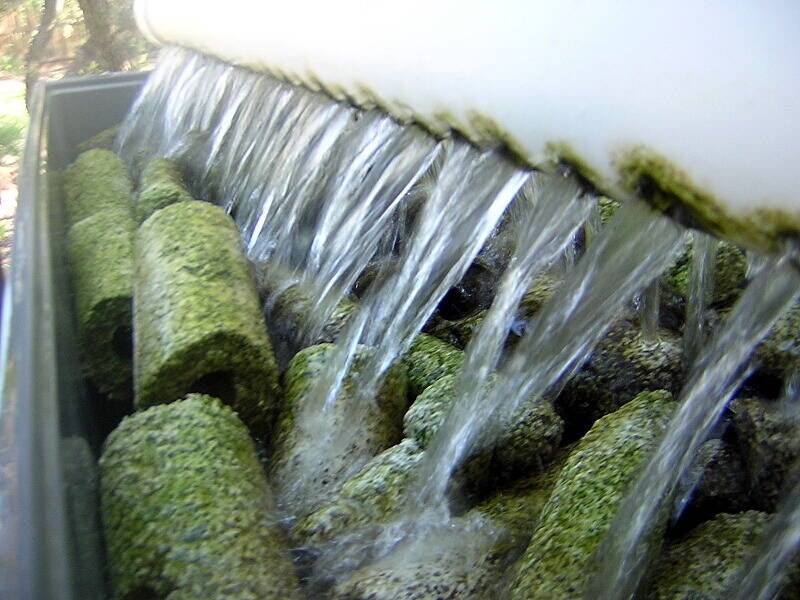
Koi pond filter media is usually divided into mechanical media (captures solids) and biological media (houses beneficial bacteria). Many filters use a combination of both.
Mechanical filter media
Filter brushes
- Long bristle brushes that trap leaves, muck, and suspended solids.
- Very durable and cheap.
- Common in settlement chambers and pre-filters.
- Need occasional cleaning.
Filter foam (sponge)
- Available in coarse, medium, and fine grades.
- Coarse foam catches larger debris; fine foam polishes water.
- Also provides some biological surface area.
- Can clog if used as the main mechanical stage on a large koi pond.
Filter floss / polyester wool
- Very fine mechanical polishing media.
- Produces very clear water.
- Blocks quickly and usually needs frequent replacement or cleaning.
Filter matting
- Sheets of Japanese matting or similar materials.
- Provides both mechanical trapping and biological surface area.
- Popular in traditional koi filtration systems.
Biological filter media
Japanese matting
- One of the classic koi filter medias.
- Open structure allows water flow and bacterial colonisation.
- Long-lasting and easy to clean.
- Often used in multi-chamber filters.
Moving bed media (K1, K3, Hel-X, similar)
- Floating plastic media that moves in an air-driven chamber.
- Excellent oxygen transfer.
- Resistant to clogging.
- Very low maintenance.
- Often considered one of the best choices for modern koi ponds.
Static K1 media
- The same type of media used without movement.
- Acts as both a mechanical trap and biological media.
- Can be flushed clean using air.
Ceramic media
Examples include ceramic rings, blocks, and porous ceramics.
- Large internal surface area for bacteria.
- Often used in smaller systems.
- Can clog if water is not well pre-filtered.
Lava rock
- Natural porous rock used historically.
- Provides bacterial surface area.
- Heavy and can trap dirt.
- Less popular in modern koi systems because it is difficult to clean.
Bio balls
- Plastic media with a large surface area.
- Good water flow through the media.
- Often used in trickle towers and wet/dry filters.
Bakki shower media
Common examples include:
- Ceramic shower media
- High-porosity mineral media
- Specialised porous blocks
Used in shower filters where water is exposed to high oxygen levels.
Polishing and specialist media
Activated carbon
- Removes some dissolved organic compounds, colours, and odours.
- Not usually needed in a mature koi pond.
- Can remove medications, so avoid using during treatments.
Zeolite
- Can absorb ammonia.
- Useful temporarily, especially in emergencies.
- Not normally relied on for permanent koi filtration.
Phosphate-removing media
- Helps control phosphate levels and algae problems.
- Usually unnecessary if stocking, feeding, and filtration are balanced.
Algae mats / mineral media
- Some products claim to bind nutrients or improve clarity.
- Results vary depending on pond conditions.
Common media combinations
Traditional multi-bay koi filter:
- Brushes
- Japanese matting
- Japanese matting + biological media
Modern low-maintenance system:
- Drum filter
- Moving bed media
- Bakki shower
Small koi pond:
- Foam/mechanical stage
- Bio balls or moving bed media
- UV clarifier
For koi, the most widely used high-performance media today are generally:
- Kaldnes K1 Media
- Japanese matting
- high-quality shower media
- Hel-X Bio Chip